


Research authors: Abbie Clare, Ruby Emerson, Britta Jewell, Thomas R. Vargas
Post author: Maja Nenadov Webster
Summary
In research commissioned by Outlier Projects, Rethink Priorities’ Global Health and Development team reviewed recent climate science and interviewed roughly 20 experts. We asked whether there is a case for the EA community to fund research on Earth systems stabilization. We concluded that there is.
The effective altruism community has historically deprioritized climate change as a cause area for two main reasons. The first is a judgment that climate change is unlikely to pose a direct existential risk to humanity (Ord, 2020; Hilton, 2022). The second is that it is not neglected: global climate funding from public and private sources reached approximately $1.3 trillion annually between 2021 and 2022 (Buchner et al., 2023; UNFCCC, 2024).
However, Earth system destabilization could be considered distinct from the broader climate change area, because it involves the triggering of mechanisms that can effectively decouple from the rise (and ideally later fall) of global average temperatures.
Evidence published since IPCC AR6 suggests that several Earth systems (ice sheets, the AMOC, planetary albedo, frozen carbon stores) are destabilizing faster than models predicted. Many of these have potentially irreversible, self-reinforcing dynamics that would be unresponsive to future reductions in global average temperatures, once triggered.
The human harms of destabilization are large even on deliberately conservative estimates. Counting only direct mortality (no morbidity, economic damage, or interactions between risks), our BOTECs find: ~15 million excess deaths by 2100 per additional degree of warming; $17.8 trillion in philanthropic value at stake from 1.5m of sea level rise (230 million people live below 1m above the high-tide line today); and $10.5 trillion in probability-weighted damages from a 15% chance of AMOC collapse.
This justifies a fund in the low- to mid-hundreds of millions. At Coefficient Giving’s (CG) old 2000x bar, each of the four risks individually supports an EA community willingness to pay of $263–445 million (single funder: $131–223 million) for research and governance work. These numbers would need to be off by 3–4 orders of magnitude for the case to entirely collapse. Moreover, CG’s bar has fallen to 1000x since publication, effectively doubling our WTP estimates for averting deaths in this cause area.
We explore the mechanisms and funding landscape of three candidate climate stabilization approaches: stratospheric aerosol injection, marine cloud brightening/thinning, and ice-sheet stabilization. All are contested, and none are deployment-ready. We recommend funding the research and governance work needed to establish whether safe, workable options exist.
What We Did
Over approximately six weeks of desk research, we surveyed the scientific literature and interviewed roughly 20 experts. We paid particular attention to research published since the Sixth Assessment Report (AR6) of the Intergovernmental Panel on Climate Change (IPCC), the UN body that periodically reviews and synthesizes climate science. AR6, completed in 2023, is the IPCC’s most recent comprehensive summary of what is known about climate change, and it remains the reference point that governments and policymakers rely on when assessing climate risk. Findings published after AR6 have therefore not yet fed into that mainstream picture, and that is where we expected to find the strongest reasons to update.
We measured harm in direct human deaths only and used conservative assumptions. Even so, our estimates suggest that destabilizing certain Earth systems could plausibly cause millions of deaths this century: roughly 2.5–4.5 million per pathway by 2100 in our central scenarios, or about 4–8 years of current global AIDS-related deaths. We also show that funding going into this area is likely small relative to the potential damage.
What Earth Systems Destabilization Means
The Earth’s climate is not a single system that responds evenly as average temperature rises. It is a collection of interconnected but distinct systems: ice sheets, ocean circulation patterns, the reflectivity of the planet’s surface and clouds, and natural carbon stores such as permafrost and wetlands, among many others. The evidence suggests that some of these systems contain ‘tipping points’, i.e., thresholds of systemic disruption beyond which change becomes self-sustaining, so the system keeps deteriorating even if the pressure that started the change later eases. AR6 identified 1.5°C of warming above pre-industrial levels as the point beyond which the risk of crossing such thresholds rises substantially (IPCC, 2023; McKay et al., 2022).
Current evidence suggests that we may spend decades of this century more than 1.5°C above pre-industrial levels. For example, even the International Energy Agency’s (IEA) most optimistic scenario projects a warming peak around 1.65°C, with temperatures returning below 1.5°C only late in the century, and it relies on carbon dioxide removal (CDR) at a scale the IEA itself calls unproven (IEA, 2025). Under the current set of national government policies, warming is set to reach ~2.5°C and still be rising by 2100, and even full delivery of every Paris Agreement pledge would still result in 2.3 to 2.5°C by 2100 (UNEP, 2025). The best realistic case therefore involves roughly 70 years above 1.5°C, in the range that AR6 flags as higher risk for crossing tipping point thresholds.
Our research covers four Earth system pathways that appear to be destabilizing as a result of rising average global temperatures:
Albedo loss. Albedo is the share of sunlight the planet reflects back into space. Ice, snow, and low clouds reflect the sun’s rays, while dark ocean and bare ground absorb them. If average temperatures melt ice and cloud-cover thins, the planet absorbs more energy, which causes a self-reinforcing cycle of further melting and warming. This feedback adds warming on top of what human-caused emissions would produce on their own, and that extra warming translates into additional heat-related deaths.
Ice-sheet instability. The West Antarctic Ice Sheet alone holds enough land ice to raise global sea levels by roughly 3.2 meters (Bamber et al., 2009), and parts of it appear to be in the early stages of a self-reinforcing retreat, in which ice loss makes further loss easier. The human stake is displacement: an estimated 230 million people currently live on land less than 1 meter above the high-tide line (Kulp & Strauss, 2019).
Disruption of the Atlantic Meridional Overturning Circulation (AMOC). The AMOC is a large ocean current system that carries warm water north through the Atlantic and helps regulate temperature and rainfall across several continents. If it collapsed, models predict severe cooling in Northern Europe and weakened monsoon rains across West Africa and South Asia, threatening the food supply of very large populations.
Warming-induced emissions. Warming causes natural systems to release greenhouse gases of their own: carbon dioxide and methane from thawing permafrost, more frequent wildfires, and warming wetlands. The northern permafrost zone alone holds roughly twice as much carbon as the entire atmosphere (Hugelius et al., 2014; Schuur et al., 2015). These releases drive further warming that no emissions policy controls, and, as with albedo loss, the human cost of that extra warming is additional heat-related deaths.
The evidence behind this has strengthened noticeably over the past few years, much of it too recent to be reflected in AR6, and it points in a worrying direction for three reasons.
First, change is arriving faster than expected. The planet is accumulating heat at nearly twice the rate climate models had predicted (Mauritsen et al., 2025), and new observational studies suggest the AMOC is weakening faster than the average of current model projections (Portmann et al., 2026). If these systems are moving faster than the models say, the harms arrive sooner, and the time available to respond is shorter than official projections imply.
Second, the risks feed each other. A comprehensive review found that most known connections between tipping elements are destabilizing, meaning that crossing one threshold makes it easier to cross the next (Wunderling et al., 2024; McKay et al., 2022). Destabilization in one system is therefore not a contained problem.
Third, the models on which official projections rest cannot fully capture this category of risk. The climate models used in IPCC assessments do not include ice sheets that respond dynamically to warming, most of the known interactions between tipping elements, or several major amplifying feedback loops. This means the projections that policymakers and funders rely on may not capture the scale of these risks. The IPCC itself increasingly recognizes the gap, and for the first time, its next assessment will include a dedicated chapter on tipping points (IPCC, 2025).
Not all of these findings are agreed on. Some researchers find no significant AMOC decline over the past 60 years (Terhaar et al., 2025), and we do not treat contested findings as established fact. But even a small probability of these systems destabilizing deserves attention if the potential harms are large enough from an expected value perspective.
The Human Harms Are Large, Even on Conservative Estimates
Evidence that these risks are real and possibly accelerating does not by itself make the case for funding. The case also depends on the scale of the harm, expressed in terms that can be compared against other giving opportunities. We therefore built back-of-the-envelope calculations (BOTECs) for each of the four pathways, estimating the human deaths each could cause by 2100. These are not climate models but deliberately simple estimates, designed to assess whether the plausible scale of human harm is large enough to justify a dedicated philanthropic fund in the low- to mid-hundreds of millions of dollars.
To translate averted deaths into an amount of philanthropic spending, we borrowed the valuation framework of Coefficient Giving (Favaloro & Berger, 2021). In that framework, one disability-adjusted life year (DALY) is valued at $100,000, each death counts as 41 DALYs lost, and a grant is worth making only if every $1 spent produces at least $2,000 of philanthropic value, known as the 2000x cost-effectiveness bar. The maximum that could be justified for an outcome at that bar is the willingness to pay (WTP) for that outcome. Note that as of this writing, the CG bar has halved to 1000x. The practical implication is that the WTP estimates for averting deaths in this cause area presented here would exactly double, making funding even more attractive.
The four pathways fall into two groups because they harm people through different channels, and the calculation has to follow the channel. Albedo loss and warming-induced emissions cause harm mainly through additional heat and subsequent heat-related mortality. So, for both pathways, we calculate the WTP for averting 0.2°C of warming. We use 0.2°C because it is the gap between the lowest warming level mainstream scenarios consider achievable (about 1.7°C) and the 1.5°C threshold where tipping risks rise substantially.
Sea level rise and AMOC collapse harm people mostly through displacement and food insecurity, so we model each against a central scenario: 1.5 meters of sea level rise by 2100 and a 15% probability of AMOC collapse by 2100. These are modeling assumptions rather than predictions, and the results should be read accordingly.
Taking the warming pathways as a worked example: each additional degree of warming on top of a moderate emissions baseline implies roughly 15 million additional deaths by 2100, broadly in line with published estimates of heat-related mortality (Rennert et al., 2022). Each death is then valued using an estimated 41 DALYs lost per death and $100,000 per DALY, which makes averting one full degree of warming worth $61.62 trillion in philanthropic value, and averting 0.2°C worth $12.32 trillion. Dividing by the 2000x bar gives $6.16 billion. This number represents the most funding that could be justifiably spent on this outcome if success were guaranteed. This is the first of three levels of funding that we calculate in the report.
The second level of funding we calculate accounts for the fact that success is not guaranteed. We therefore scale Level 1 down by two considerations to reach Level 2, our estimate of what the EA-aligned community as a whole could justify committing. The first is the probability that funded research actually leads to a deployed intervention that delivers the target outcome, which we set at 10%, since the chain from research through governance to deployment is long even when the science is mature. The second is the share of credit attributable to EA-aligned funders rather than to governments or mainstream climate philanthropy, which we set at 50%, because the field is currently small enough that EA giving of this size would plausibly account for about half of relevant philanthropic spending over the next five years. Together, these leave 5% of Level 1 (10% × 50%), or $308 million.
Level 3, what a single funder could justify, applies one further 50% adjustment because no single funder is likely to cover a whole cause area: $154 million.
Applying the same three levels across all four pathways produces the figures below, in millions of USD:
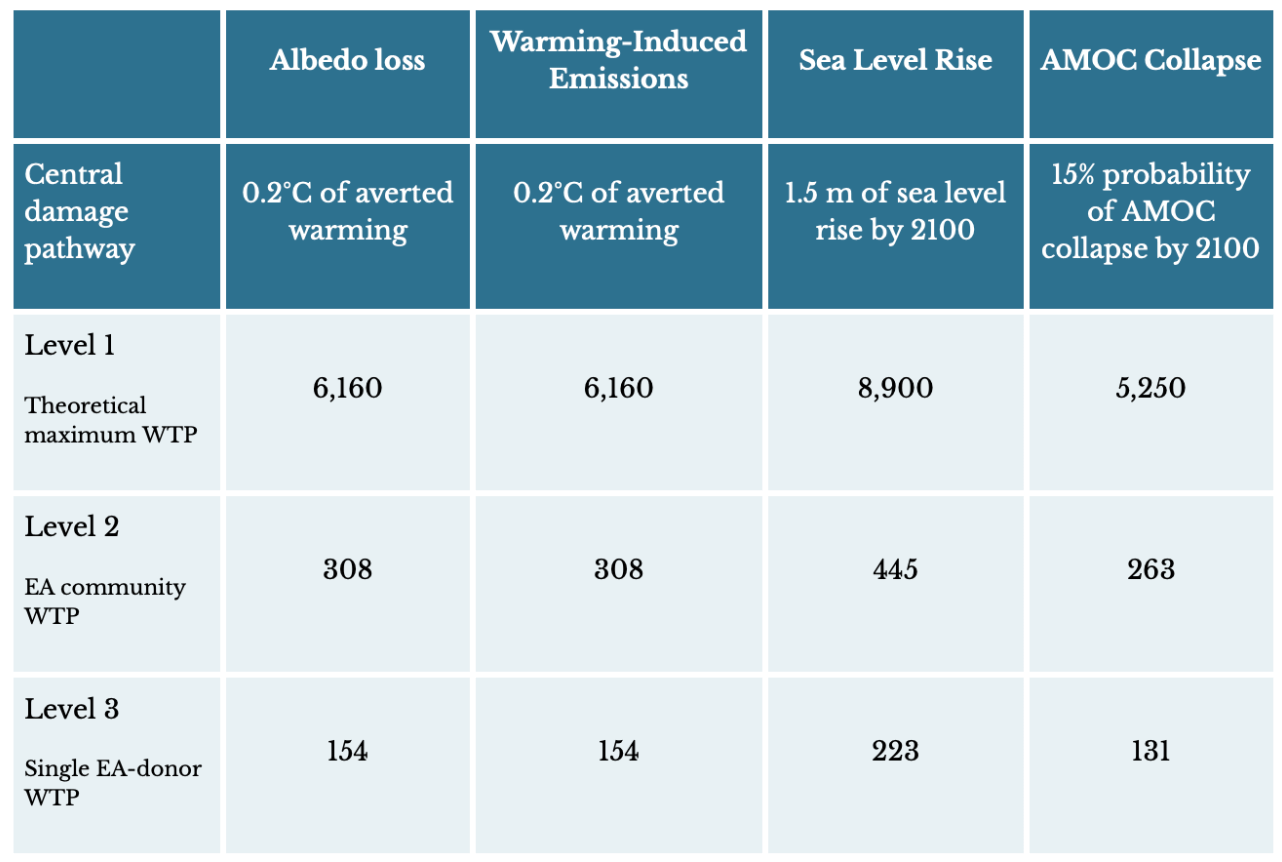
Each pathway independently supports an EA community commitment of between $263 million and $445 million, and a single-funder commitment of between $131 million and $223 million. The first two columns are identical because both pathways share one calculation.
Four things to keep in mind when reading these numbers:
These are not cost-effectiveness estimates for deploying interventions. Rather, these figures represent what could be theoretically justified for grants advancing the science and governance of keeping Earth systems stable.
They are conservative by design. We count only direct deaths from excess heat, displacement, and food scarcity. We exclude illness, deaths from other causes such as disasters, and all economic and social damage. We model the four pathways as if they were independent, when in reality they interact and compound one another. We also make no attempt to quantify harms to animals. Based on previous work, we believe the mortality figures alone understate the true harms by at least a factor of two.
They are sensitive to central assumptions in both directions. Under plausible alternative scenarios, such as a 2-meter sea-level rise or a 40% probability of AMOC collapse, the justified figures rise substantially. Conversely, if our central assumptions are too pessimistic, the figures would fall, though not necessarily by the same amount.
Our confidence varies. We are most confident in the Level 1 arithmetic for the two warming pathways, where the calculation is simple, and the mortality inputs match published work. We have somewhat less confidence in the sea-level rise and AMOC figures because the chain from displacement or food insecurity to deaths is longer. Levels 2 and 3 rest on the adjustments described above, and reasonable people could set those differently.
Even so, the headline conclusion is robust to a great deal of disagreement. Our inputs would need to be wrong by three to four orders of magnitude before the case for a fund in this size range fell apart.
Candidate Research Directions
The approaches below aim to fill that gap by keeping at-risk Earth systems stable directly while emissions cuts and carbon removal take effect. We assessed three candidates:
Stratospheric aerosol injection (SAI) would disperse reflective particles into the stratosphere, roughly 15 to 25 kilometers up, to reflect a small share of sunlight back into space, similar to the temporary cooling caused by large volcanic eruptions.
Marine cloud brightening (MCB) and mixed-phase cloud thinning (MCT) would modify clouds to either reflect more sunlight or allow more heat to escape, potentially offering targeted protection for regions like the Arctic or coral reefs.
Ice-sheet stabilization encompasses engineering approaches that would slow the sliding of glaciers into the ocean, for example, by removing the meltwater beneath them that acts as a lubricant.
These approaches face significant opposition. The EU’s scientific advisors have recommended a Europe-wide moratorium on solar radiation modification, the category covering SAI and MCB (European Commission, 2024), and over 600 scholars have called for an international non-use agreement (Solar Geoengineering Non-Use Agreement, 2022; Biermann et al., 2022). Critics argue that the risks are poorly understood, that a fallback option could weaken pressure to cut emissions, and that no one has the authority to decide on behalf of the world whether to use such tools. We address these objections in the full report. Our focus is the case for funding research and governance work; whether to deploy any of these interventions is a separate question that this research would help inform.
We conclude that there is significant space for growth. These fields are very small: research on MCB and MCT runs at roughly $5 to 10 million per year, and cumulative philanthropic funding for ice-sheet stabilization is under $20 million. Funding for solar radiation modification, of which SAI is the largest component, is the exception, nearly tripling in 2025, with public funding accounting for most of the increase (Geoengineering Monitor, 2026). But that money is concentrated in physical science, while the binding constraints are governance, equity, and political legitimacy. Modest research funding could resolve the open questions in either direction. If these approaches work, early research means they are understood well enough to be governed responsibly. If the approaches do not work, that becomes clear before far larger sums are committed.
We offer these as candidate directions with caveats attached. The case for funding does not rest on any single approach proving viable. It rests instead on there being potentially promising ideas out there that could use additional resources to resolve outstanding questions about their harm mitigation potential.
Bottom Line
Counting only direct human deaths and using conservative assumptions, each of the four Earth systems destabilization pathways we examine could justify an EA community commitment in the low-to-mid hundreds of millions of dollars at a standard cost-effectiveness bar. The realistic trajectory of emissions policy leaves the world exposed to these risks for decades. We think the existing evidence justifies an EA-aligned fund focused on Earth systems stabilization research and governance.
Read More
The full report, Earth Systems Risks and the Case for Funding Stabilization Research, is available on Rethink Priorities’ website.
For any questions about this research, please reach out to ghd@rethinkpriorities.org.
Funders interested in supporting research to avert catastrophic climate risks can learn about the Earth Systems Stabilization Fund, managed jointly by Outlier Projects and The Navigation Fund.
Acknowledgments
This summary is based on original research by Abbie Clare, Ruby Emerson, Britta Jewell, Thomas R. Vargas. Thanks to Maja Nenadov Webster for writing the summary and Urszula Zarosa for editing.
Thank you!
Thank you for taking the time to read our Substack. We will continue to provide this content on a regular basis. If you would like to support our efforts, please subscribe below or share our posts with friends and colleagues.
We are also always looking for feedback on our work. You can share your thoughts about this publication anonymously or reply to this email/post with suggestions for improvement or any questions.
Parts of this content were prepared with the assistance of AI tools (such as Claude and Gemini), which we use to improve efficiency and readability. All outputs are supervised, reviewed, and fact-checked by RP staff, who remain responsible for the final content.
I'm really glad to see the Rethink taking this issue seriously!
> The effective altruism community has historically deprioritized climate change as a cause area for two main reasons. The first is a judgment that climate change is unlikely to pose a direct existential risk to humanity (Ord, 2020; Hilton, 2022). The second is that it is not neglected
As a longtime EA I've been incredibly frustrated and embarrassed with the movement's following this reasoning, which seems to me to be far too heuristics-based for a movement that prides itself on evidence and reason.
On the idea that it doesn't pose an 'existential risk', I've written extensively on why the idea of distinguishing existential and other catastrophic risks doesn't make sense on its own definitions (https://forum.effectivealtruism.org/s/gWsTMm5Nbgdxedyns) - tl;dr, it tries to impose categorical reasoning (whether we're in state beyond some threshold) on an obviously quantitative question (how bad a given state is, and what our prospect of success from it is).
I've also written on why extinction specifically isn't that quantitatively different in expectation from civilisational collapse, even on totalising axiologies (https://forum.effectivealtruism.org/posts/CxMusuX8E5hiTXEWX/fruit-picking-as-an-existential-risk)
On non-neglectedness, I and many others (https://forum.effectivealtruism.org/topics/itn-framework) have repeatedly made the point that 'neglectedness' is again a heuristic, and one with only limited utility to prioritisation under real-world uncertainties. Here's a potted summary I wrote recently:
It has three related problems:
1. EA analyses tend to use ITN as three independent multiplicative factors of value. But reasonably understood, 'importance' and 'tractability' are synonymous with 'benefit' and 'cost'. That is, they are the factors constituting total value, such that when you know them, you know total value. 'Neglectedness' isn't a third factor, and so should never be used multiplicatively† - it's a heuristic that under high uncertainty can nudge you towards less-worked-on causes. But climate change has some of the lowest uncertainty in the GCR space, so neglectedness should be a commensurately low-weighted concern.
2. The value yielded by real-world problem solutions looks less like (say) a diminishing returns curve and more like an S-curve. This means that early work has *less* direct value than mid-solution work, and the counterfactual is very complicated in either case. So whether or not climate is the best problem to work on, in isolation this might be the best time to work on climate change!
3. The shape of the diminishing-returns part of the curve depends on what you could call the extent of the problem (which might be a third factor, or might just be a function of importance and tractability). If you can reduce expected warning by n°C and that gets it close enough to 0 that the next person to work on it can only reduce it by a further n/2 then (sidestepping the actual calculus) you've done a lot less counterfactual good than if the problem extends far enough that the next person can also reduce it by something close to n°C. In practice, climate change is an enormous problem, far closer to the latter.
† I know Owen Cotton-Barratt treated tractability and neglectedness as factors here https://80000hours.org/articles/problem-framework/, but this is defining tractability as elasticity of tractability, which isn't how anyone really thinks about it
I'm not saying EAs should substantially refocus on climate change, but I don't think they should ever have avoided it for *this* reason.