

Which charitable causes do U.S. adults care most about?
Insights from RP’s "Pulse" project

Research authors: Jamie Elsey, David Moss
Summary author: Thais Jacomassi
Recently released findings from the second wave of RP’s Pulse project aim to understand the U.S. public’s attitude towards effective giving and various impactful cause areas. This latest wave of Pulse, conducted between February 2025 and April 2025 (about six months after the first wave, which began in July and ended in September of 2024), canvassed approximately ~5,600 respondents on these matters. In this article, we focus solely on the U.S. public’s perception of different philanthropic cause areas and their support for charitable donations to these causes. See our recent summary of U.S. attitudes towards artificial intelligence here, and that of U.S. attitudes towards Effective Altruism (EA) here.
Why this research matters
Wave 2 of Pulse collected data during a particularly significant period of time following President Trump’s inauguration and his administration’s cuts to USAID. As a result, the survey was well-positioned to provide crucial insights into potential shifts in the public’s prioritization of different cause areas.
For the philanthropy sector and grantmakers, these insights reveal which causes resonate most with potential donors and where outreach might be needed to build support for underfunded but high-impact areas.
For EA organizations and advocates, the data highlights the gap between public intuition and the causes that the EA community prioritizes. It’s worth considering what outreach and communication strategies might better align public perceptions and attitudes with causes thought to have the most leverage by the EA community.
For policymakers, understanding public priorities across partisan lines can help identify opportunities for crafting messages that resonate broadly. While there were few changes between Wave 1 and Wave 2, political polarization remained notable in certain cause areas.
Key findings
All cause areas received favorable ratings, though traditional causes still dominate.
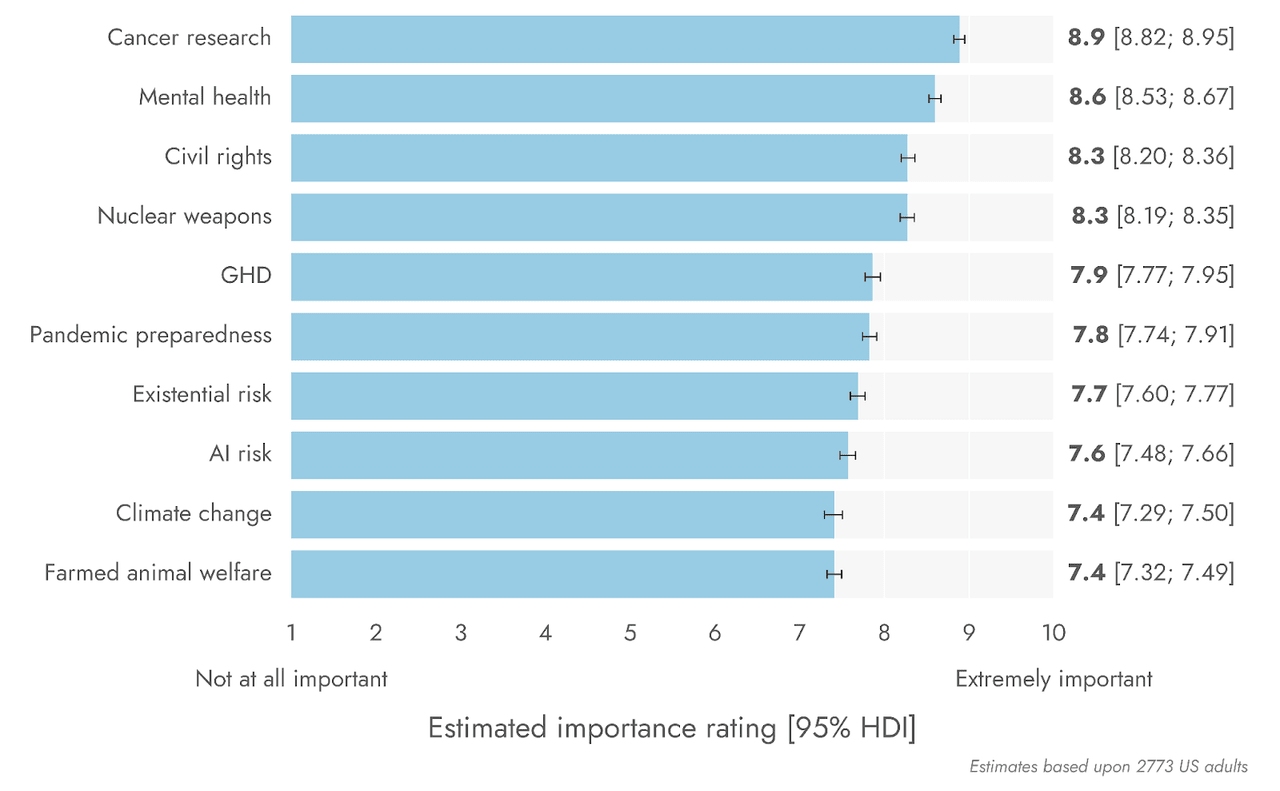
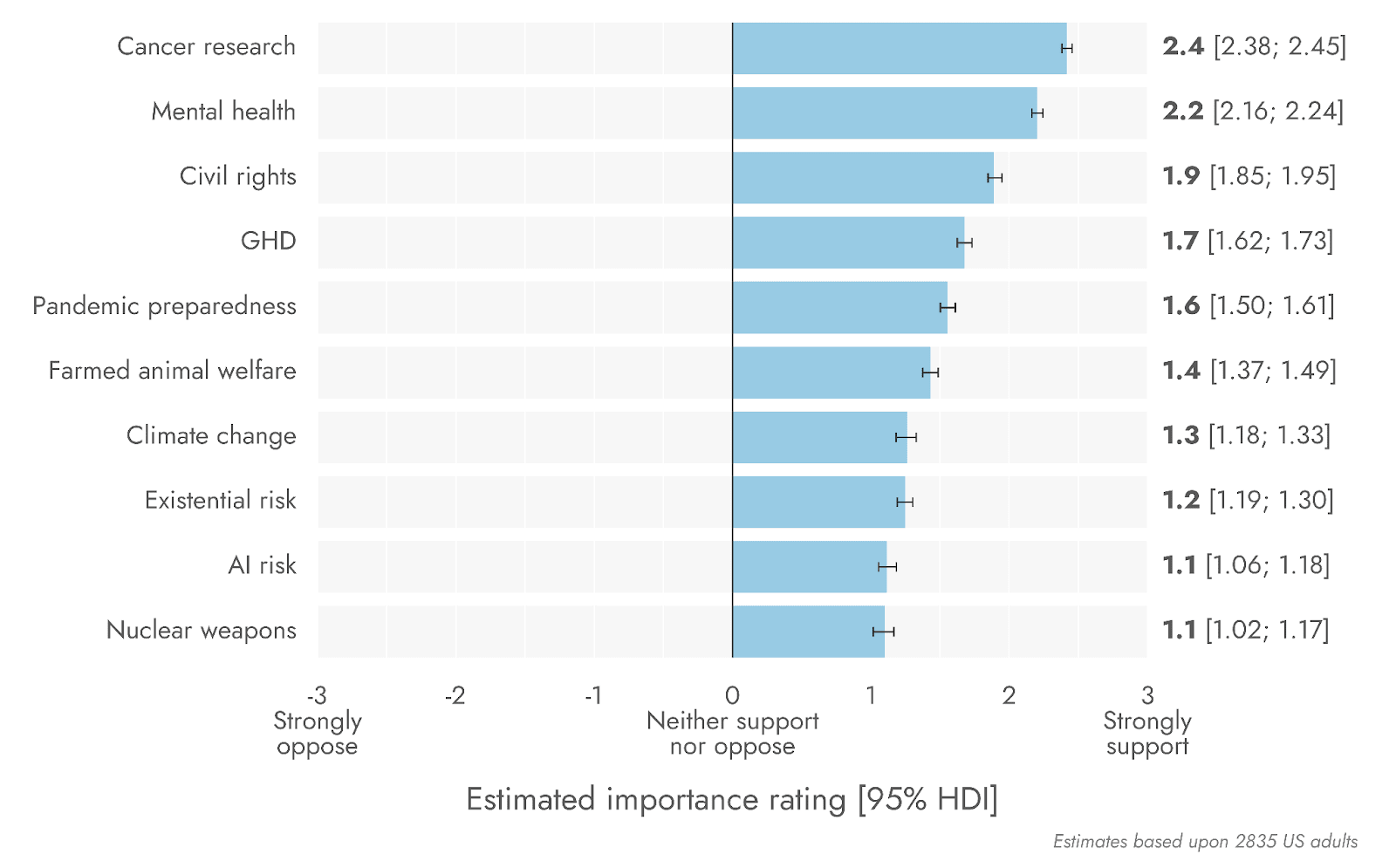
Traditional causes (i.e., Cancer Research and Mental Health) received the highest ratings for both importance (8.9 and 8.6 out of 10, respectively) and support for donations (2.4 and 2.2 on a -3 to +3 scale).
Farmed Animal Welfare and Climate Change ranked lowest in importance (both at 7.4 out of 10), while Nuclear Weapons and AI Risk received the lowest donation support (both at 1.1 from -3 to +3).
However, all causes received high ratings (see Figure 1), with even the “lowest” ranked causes averaging at 7.4 out of 10. This suggests that none of the cause areas were dismissed outright.
Nuclear Weapons presented a disconnect.
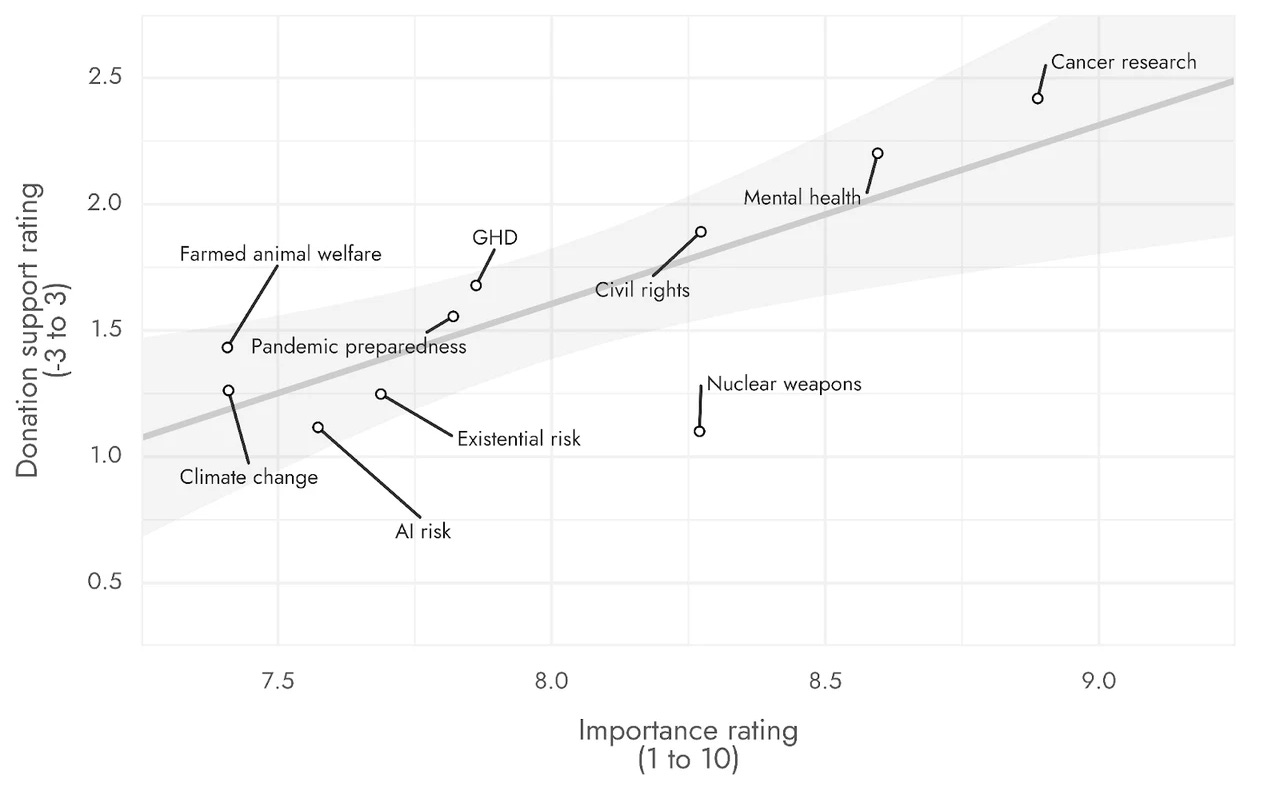
Despite ranking fourth in importance (8.3 out of 10), Nuclear Weapons received the lowest donation support alongside AI Risk.
This divergence is unusual because importance ratings and donation support were otherwise tightly coupled across all other cause areas (see Figure 3).
We think this gap probably reflects that people are not aware of donation opportunities related to nuclear risk that could make a difference, rather than opposition to the cause itself.
Wave 1 and Wave 2 of Pulse showed remarkable stability despite major political changes in the meantime.
None of the cause areas showed significant shifts between Wave 1 (July to September 2024) and Wave 2 (February to April 2025) even though this period of time included a presidential election and substantial changes in foreign policy.
The ranking of causes was almost entirely unchanged, with only Civil Rights swapping positions with Nuclear Weapons for third place (even then, both were essentially unchanged at 8.3).
Global Health and Development (GHD) presented the largest (though not statistically significant) downward trend, particularly among Republicans. This modest shift may signal that the White House’s cuts to global aid have begun to shift public perception. Wave 3 will help to determine if this is a sustained trend.
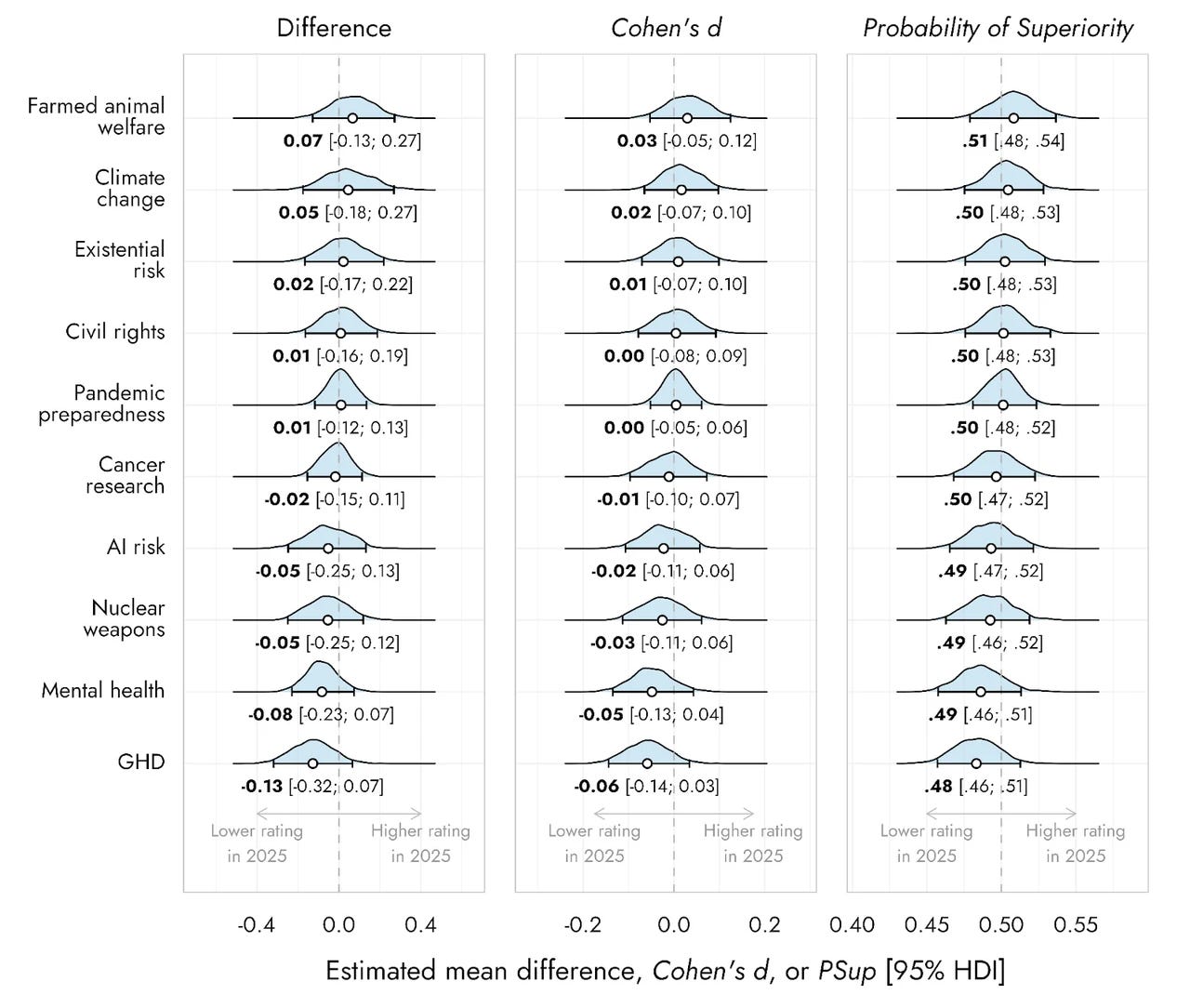
Political polarization was concentrated in specific issues.
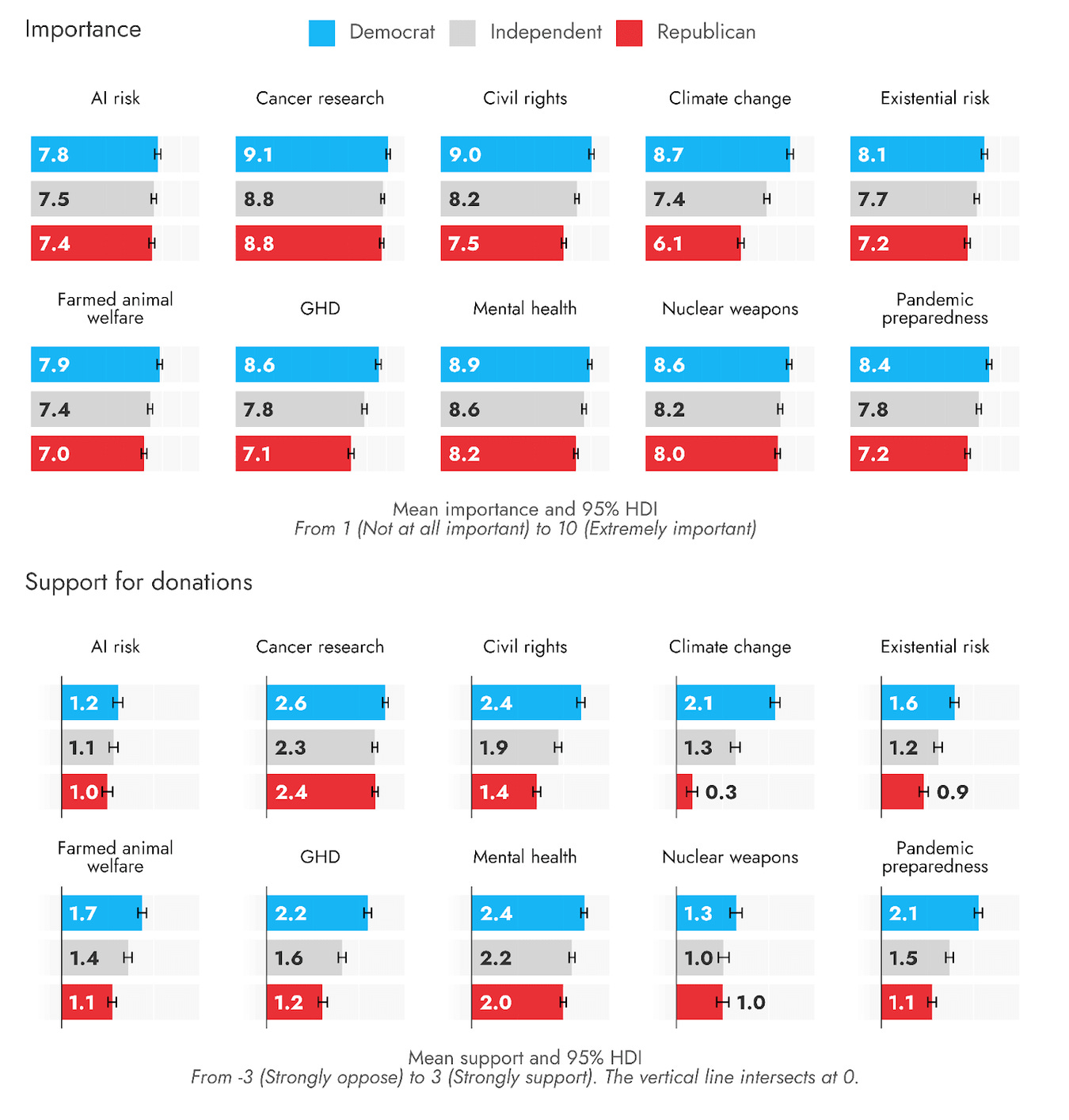
Climate Change showed a stark partisan divide, with Republicans rating it substantially lower than Democrats in both importance and donation support.
Other causes with sizable differences between Republicans and Democrats included Civil Rights, Farmed Animal Welfare, and GHD.
Many causes, such as Cancer Research, Mental Health, and AI Risk showed relatively consistent support across party lines.
These political patterns remained largely stable from Wave 1, though small shifts in GHD importance among Republicans (-0.25 points down) and Independents (-0.11 points down) warrant future monitoring in Wave 3.
Read the full write-up
The complete analysis, including detailed comparisons between all cause areas and methodological notes, is available on the EA Forum. Stay tuned for additional findings!
Acknowledgements
Thank you to Thais Jacomassi for writing the research summary for this Substack and to Jamie Elsey, Elisa Autric, and Urszula Zarosa for review.
Thank you!
Thank you for taking the time to read our Substack. If you would like to support our efforts, please subscribe below or share our posts with friends and colleagues.
We’re also always looking for feedback on our work. You can share your thoughts about this publication anonymously or simply reply to this email/post with suggestions for improvement or any questions.
By default, we’re sharing this Substack via email with Rethink Priorities newsletter members. Please feel free to unsubscribe from this Substack if you’d prefer to stick with our monthly, general newsletter.